Quality Control in Board Game Manufacturing: A 4-Stage QC System Explained
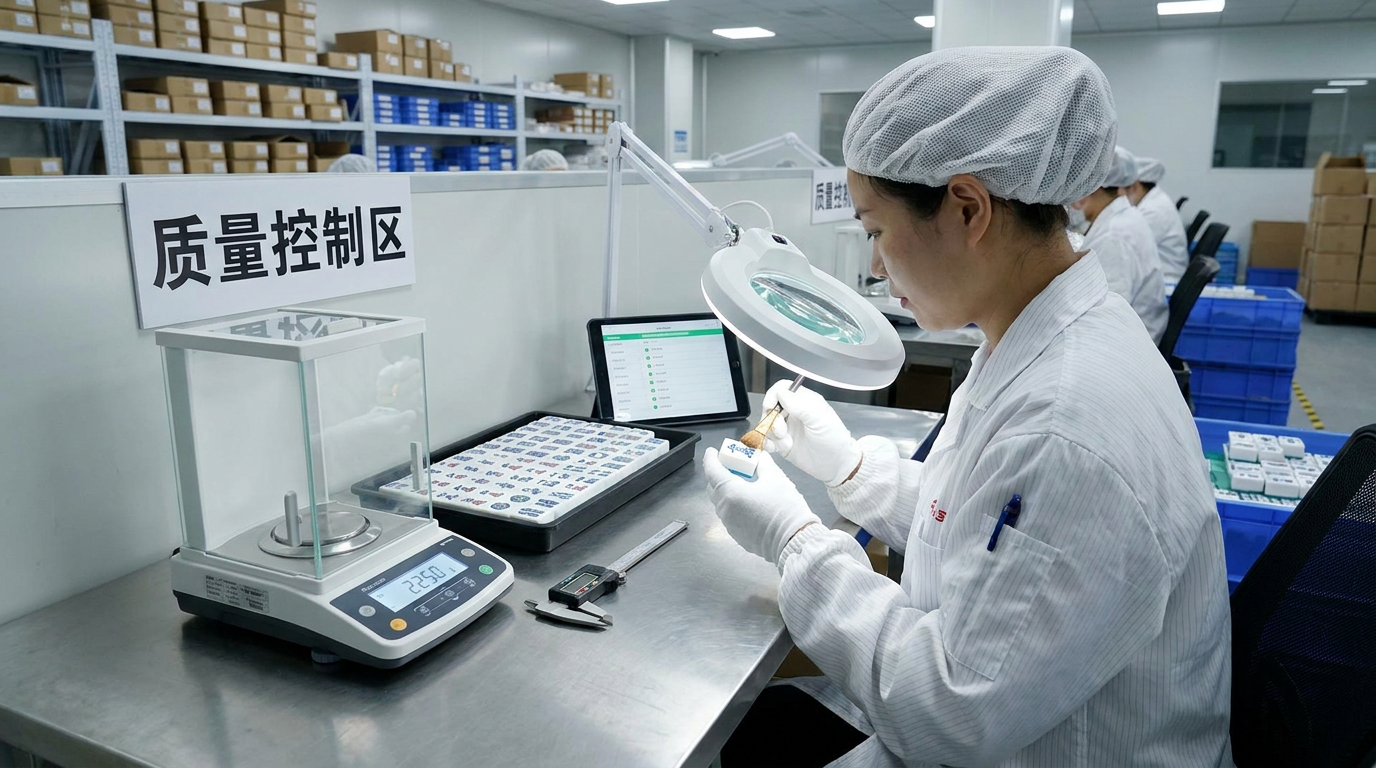
How a specialized mahjong factory controls quality from raw material to export carton — the four inspection stages and the standards behind each.
Stage 1: Incoming Material Inspection
Every batch of acrylic compound, melamine resin and packaging stock is inspected on arrival against the specification that the approved sample was built on. Color consistency, sheet thickness, density — rejected material never enters production, because no downstream inspection can undo a bad input.
Stage 2: In-Process Dimensional Control
During molding and cutting, line QC samples tiles against go/no-go gauges: length, width, thickness and squareness. Tile dimensional consistency is what makes a wall stand and a pusher glide — tolerances are held tight enough that tiles from different production days are interchangeable.
Stage 3: Finished-Set Audit
Assembled sets are audited under high-intensity standardized lighting: symbol clarity, engraving depth, color match to the Pantone-approved reference, and a functional check of racks and pushers. This is a 100% appearance standard for boutique programs, sampled AQL for volume lines.
Stage 4: Wear Testing and Export Packing
Batch samples go through wear-resistance testing — simulated shuffling abrasion, color-fastness under UV, and drop testing for cases. Only after this do sets receive their final export packing, sealed against the humidity and compression realities of a container crossing the Pacific.